
Standard Penetration Testing: Calibrating True N-Values
-
The Dilemma of Uncalibrated Field N-Values
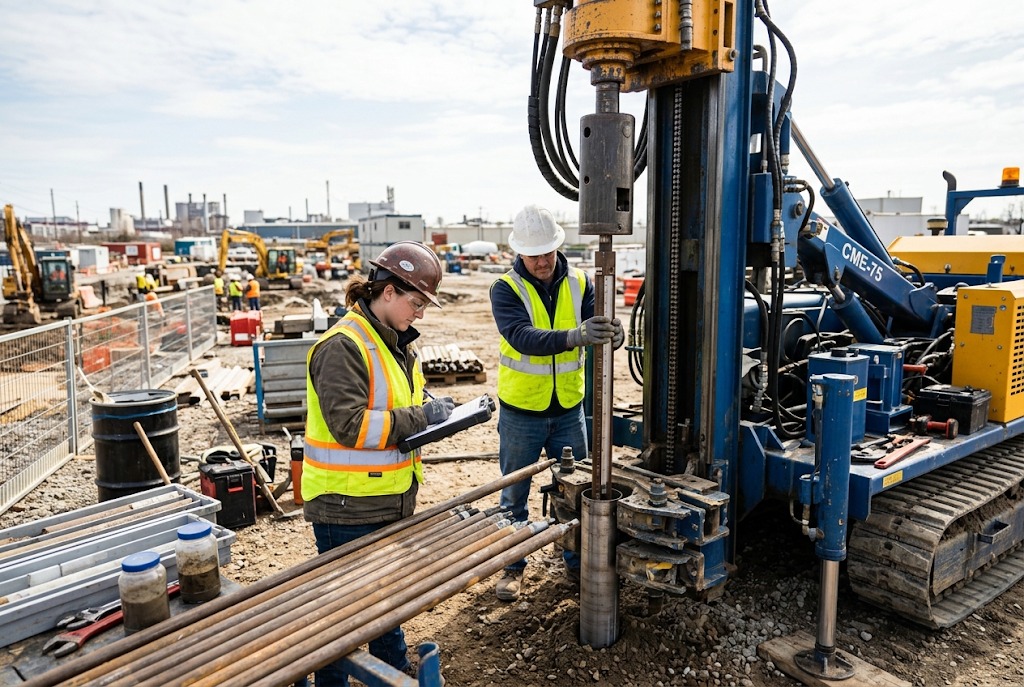
The Standard Penetration Test (SPT) remains the global baseline for empirical geotechnical design. From determining the allowable bearing capacity ($q_{allow}$) of shallow footings to calculating skin friction and end-bearing resistance for deep bored piles, structural engineers depend heavily on the field penetration resistance index, or N-value (blows required to drive a split-spoon sampler 300 mm into virgin ground).
However, an uncalibrated raw field N-value ($N_{field}$) is inherently flawed. In traditional manual or semi-automated drilling operations, energy delivered to the drill rods fluctuates wildly due to cathead friction, operator fatigue, rope degradation, eccentric hammer impact, and drill rod length variations. Relying on raw blow counts without energy calibration creates dangerous vulnerabilities: either severe structural under-design that risks differential settlement and failure, or massive over-design that inflates foundation construction budgets.
-
The Physics of Impact Mechanics & The Energy Ratio (ER)
Under standardized ASTM and ISO formulations, the theoretical potential energy ($E^*$ = 474 Joules or 350 ft-lbs) of a 63.5 kg (140 lb) hammer freely falling through 760 mm (30 inches) is rarely achieved in the field. The actual kinetic energy transferred down the drill string ($E_{actual}$) is governed by the system's Energy Ratio (ER):
$$ER = \left( \frac{E_{actual}}{E_{theoretical}} \right) \times 100\%$$
Manual rope-and-cathead systems frequently deliver an erratic energy efficiency of only 35% to 55%, whereas modern automated trip-hammer mechanisms consistently achieve 65% to 85% calibrated energy transfer. A soil layer that records 20 blows under an inefficient 45% hammer might record only 12 blows under a standardized 75% hammer—a 40% variance that fundamentally alters engineering classifications.
-
Mathematical Normalization: Standardizing to N60 and (N1)60
To eliminate equipment and field discrepancies, modern geotechnical engineering codes (including Eurocode 7, BS 5930, and ASTM D6066) require standardizing raw field blow counts to an internationally recognized reference energy baseline of 60% delivered energy ($N_{60}$) using rigorous calibration factors:
$$N_{60} = N_{field} \times \left( \frac{E_m}{60} \right) \times C_B \times C_S \times C_R$$
Where:
• $E_m$ (Hammer Efficiency Ratio): Measured delivered energy percentage.
• $C_B$ (Borehole Diameter Correction): Adjusts for stress relief in larger boreholes (1.00 for 65–115 mm; 1.05 for 150 mm; 1.15 for 200 mm).
• $C_S$ (Sampler Correction): Accounts for split-barrel samplers with or without internal core liners (1.00 standard lined; 1.20 unlined loose sand).
• $C_R$ (Rod Length Correction): Compensates for energy transmission reflection in short drill strings ($C_R$ = 0.75 for < 4 m, progressing to 1.00 for > 10 m).
For seismic liquefaction potential and granular soil relative density ($D_r$), this value is further normalized against effective overburden stress ($\sigma'_v$) to derive $(N_1)_{60}$ using the stress factor $C_N$:
$$(N_1)_{60} = N_{60} \times C_N = N_{60} \times \sqrt{\frac{P_a}{\sigma'_v}}$$
*(where $P_a$ is atmospheric pressure $\approx$ 100 kPa)*.
-
Technical Comparison: Automated Trip Hammers vs. Manual Catheads
- Free-Fall Precision: Automated trip hammers utilize internal mechanical release catches that lift the 63.5 kg counterweight to exactly 760 mm before a pure, unhindered gravitational free fall, eliminating the 15–30% frictional drag caused by revolving cathead drums and operator slip.
- Vertical Alignment & Impact Coaxiality: Automated systems guide the hammer along an enclosed, low-friction internal drive shaft, ensuring perfectly perpendicular, concentric strikes onto the anvil without energy-dissipating rod eccentricities or lateral whip.
- Operator Independence & Repeatability: Blow rate and drop height remain identical across every single test depth, eliminating operator fatigue bias during deep drilling campaigns exceeding 30–50 meters.
- Real-Time Energy Instrumentation: Field instrumentation measures force and velocity wave traces (via accelerometers and strain transducers per ASTM D4633), directly verifying the exact kinetic energy entering the anvil.
-
Downstream Engineering Impact: Safety & Value Optimization
Direct Design Implications: Calibrated $N_{60}$ and $(N_1)_{60}$ values directly determine the safety and economic efficiency of civil infrastructure:
- Optimized Bored Pile Socketing: Accurately distinguishes between weathered Grade IV/V saprolites and sound Grade I/II bedrock, ensuring piles are socketed to exact engineering depths without wasteful over-drilling into competent rock.
- Accurate Settlement Predictions: High-precision N-values yield true constrained deformation moduli ($M_v$ and $E_s$), eliminating over-conservative settlement estimates that unnecessarily force projects into expensive deep foundation systems.
- Definitive Liquefaction Assessment: Cyclic Resistance Ratio (CRR) curves in seismic evaluations rely strictly on calibrated $(N_1)_{60cs}$ values; uncorrected data can falsely trigger costly ground improvement mandates (such as vibro-replacement or jet grouting).
-
The Bayleys Standard in In-Situ Metrology
At Bayleys Environmental Services (Pvt) Ltd., precision in-situ metrology is non-negotiable. Our drilling fleet is exclusively equipped with factory-calibrated automated trip-hammer assemblies and standardized tooling conforming to ASTM D1586, ASTM D4633, BS 5930, and EN ISO 22476-3. By standardizing every penetration increment to true $N_{60}$ telemetry, we provide structural engineers with definitive geotechnical confidence from the ground up.
-
Technical Inquiry & Foundation Metrology Advisory
Ensure your structural foundations are designed on calibrated, verifiable ground parameters.
Contact Our Geotechnical Metrology Division:
• Email: bayleyswelcome@gmail.com
• Hotline: +94 77 113 2196 / +94 76 638 3444
• Corporate Office: No. 255/9, St. Mary Estate, Wewalduwa Road, Hunupitiya, Wattala, Sri Lanka
Add New Comment