
Maximizing Core Recovery in Complex Geological Strata
-
The Hidden Peril of Missing Subsurface Layers
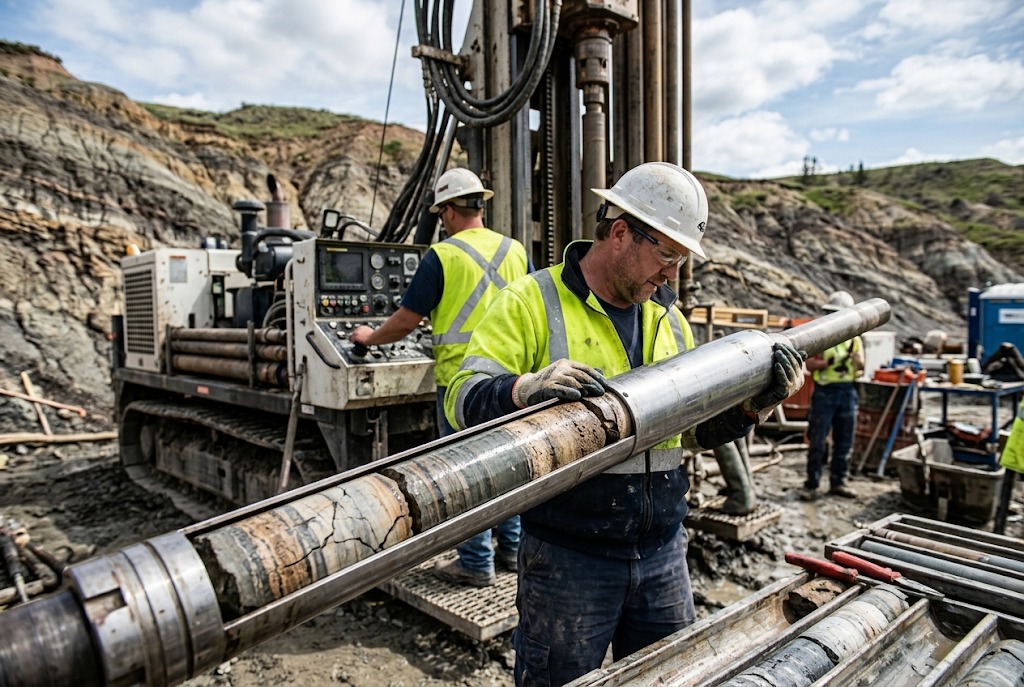
In geotechnical site exploration, what you fail to recover is far more dangerous than what you bring to the surface. The most catastrophic ground failures in civil engineering—such as progressive slope collapses, sudden pile punch-throughs, and excessive differential foundation settlements—are rarely caused by competent solid bedrock. Instead, they are triggered by thin, undetected weak seams: soft marine clay lenses, slickensided shear planes, highly weathered saprolite zones (Grade IV/V), or loose, water-bearing sand pockets.
When conventional drilling techniques wash out or grind away these sensitive intermediate strata, engineers are left with empty spaces in the core box and false assumptions on design logs. Achieving pristine, uncompromised continuous sample recovery across complex, variable geological strata is the fundamental prerequisite of safe civil and structural engineering.
-
Mechanics of Failure in Conventional Core Barrels
Legacy Core Barrel Constraints: To understand why weak strata disappear during exploration, one must analyze the mechanical limitations of legacy barrel systems:
- Single-Tube Barrels (Direct Flushing & Rotational Torsion): In single-tube assemblies, high-pressure drilling flush washes directly over the newly cut core as it enters the barrel. Furthermore, the rotating inner wall of the barrel exerts immense torsional shear against the core. In soft clays, weathered rock, or loose sands, this results in immediate sample erosion, core grinding, and catastrophic sample washouts.
- Conventional Double-Tube Swivel Barrels (T-Series / Standard NQ/HQ): While an isolated inner barrel protects the core from rotational spinning, the extraction phase remains destructive. To remove the core from the solid inner tube, technicians frequently use manual tapping, shaking, or pressurized water ejection. This mechanical disturbance shatters friable cores, distorts natural joint orientations, and destroys delicate clay fabrics, rendering the recovered core useless for undisturbed triaxial or shear strength laboratory testing.
-
Triple-Tube Split-Inner Architecture (HQ3 / NQ3)
Engineered Mechanical Separation: Triple-tube core barrel systems (such as HQ3, NQ3, and PQ3) are engineered specifically to eliminate both hydraulic erosion and mechanical extraction damage. The system incorporates an advanced three-tier mechanical assembly:
- Outer Rotating Barrel: Transmits rotational torque and axial feed thrust from the rig spindle down to the diamond-impregnated matrix bit.
- Stationary Bearing-Decoupled Inner Barrel: Mounted on precision bearing swivels, this assembly remains stationary as the bit cuts downward, routing 100% of high-pressure drilling fluid through the annulus between the outer and inner tubes—completely shielding the cut core from fluid wash.
- Longitudinal Split Inner Liner (The Third Tube): Encased within the stationary inner barrel is a precision two-piece longitudinally split steel or brass sleeve that holds the core snugly as it enters. Upon reaching the surface, the split sleeve is hydraulically pumped out of the barrel and opened laterally, exposing the intact core in its native state without tapping, vibration, or bending stresses.
-
Quantitative Metrology: TCR, SCR, and True RQD Logging
Definitive Geological Telemetry: The deployment of triple-tube split inner barrels transforms subsurface data quality across all primary quantitative logging indices:
- Total Core Recovery (TCR $\approx$ 95%–100%): Guarantees that every centimeter of depth is accounted for, capturing friable clay infills, gouge material along fault lines, and unconsolidated sand lenses that would otherwise wash out.
- Solid Core Recovery (SCR) & Rock Quality Designation (RQD): Eliminates mechanical drilling-induced fractures. True natural joints, slickensides, and hydrothermal alteration bands are preserved exactly as they exist in-situ, ensuring Rock Mass Rating (RMR) and Geological Strength Index (GSI) calculations are accurate rather than artificially deflated.
- Undisturbed Sample Extraction for Laboratory Geotechnics: Preserves intact cylindrical core plugs from weathered horizons suitable for Unconfined Compressive Strength (UCS), Point Load Index ($I_{s(50)}$), and direct shear testing along native discontinuity planes.
-
Synergistic Polymer Fluid Hydraulics & Bit Selection
Hydraulic & Tooling Synergy: Triple-tube barrels achieve optimal results when paired with modern drilling fluid engineering and tailored diamond tooling:
- Pressure-Balanced Polymer Drilling Muds: High-yield bentonite or biodegradable synthetic polymer muds form an ultra-thin, impermeable filter cake along borehole walls, stabilizing unconsolidated sand horizons and balancing artesian pore pressures.
- Face-Discharge Diamond Bits: Specially engineered diamond bits discharge cooling fluid directly across the cutting face through perimeter channels rather than washing across the core entry throat, minimizing hydraulic jetting damage against soft rock matrices.
-
Technical Standards & The Bayleys Drilling Standard
At Bayleys Environmental Services (Pvt) Ltd., exploratory diamond core drilling strictly adheres to international standards:
- ASTM D2113: Standard Practice for Diamond Core Drilling for Site Investigation.
- BS 5930: Code of Practice for Ground Investigations.
- EN ISO 22475-1: Geotechnical Investigation and Testing – Sampling Methods and Groundwater Measurements.
Our fleet of track-mounted crawler rigs and heavy-duty drilling units standardizes triple-tube split-barrel tooling on all complex infrastructure projects, providing civil engineers and consultants with uncompromised geological ground truth.
-
Project Ground Investigation Advisory
Planning critical foundation exploration, slope stability investigations, or over-water drilling? Ensure your core logging reflects 100% of subterranean reality.
Contact Our Core Exploration & Geotechnical Division:
• Email: bayleyswelcome@gmail.com
• Hotline: +94 77 113 2196 / +94 76 638 3444
• Corporate Office: No. 255/9, St. Mary Estate, Wewalduwa Road, Hunupitiya, Wattala, Sri Lanka
Add New Comment